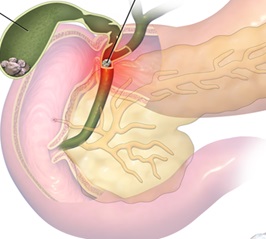
We all have a small sac like organ below the Liver called as at Gall Bladder. Liver synthesizes green colour liquid called as Bile Salts which is essential for digestion of fatty food primarily and partly proteinacious food. During the time when our ingested food enters into first part of small intestine after being processed by Hydrochloric acid in stomach, the fatty content inside the intestine stimulate brain to release bile from liver. At times when we are fasting then the excess bile is stored inside the Gallbladder. A Gall bladder can store 50 to 100cc of bile in liquid state at resting stage.
The inner lining of Gall bladder wall is responsible to keep the stored bile in liquid state. When some abnormalities happen in the lining epithelium or due to some metabolic changes, gall bladder starts concentrating bile and results in formation of bile sand called as Biliary Sludge. Further concentration can lead to formation of small stones which in multiple number can coalesce to form big stone inside the Gall bladder thus resulting in Gall stone disease.
WHAT ARE THE SYMPTOMS of Gall stone disease?
Patients with Gall stones has a non functioning gall bladder and once stone is formed inside patient started getting mild to moderate digestive problems like bloating, feeling of right sided upper abdominal discomfort, sense of indigestion or heaviness after meals or even gastritis. Small stones has the potential to slip from gall bladderneck and can get trapped inside lower end of wide bile duct called as Common bile duct. Small stones trapped there can give rise to increasing Jaundice with sudden pain and fever and resulting in surgical emergency. It can also give rise to a more morbid condition called as Acute pancreatitis. Both of the above problem demands urgent hospital admission and immediate endoscopic intervention followed by surgery.
Large stone can get blocked inside gall bladder and can give rise to episodes of repeated infection and swelling resulting in recurrent right upper abdominal severe to moderate pain. Pain can radiate to right upper back bone and can be associated with fever in case of infection.
WHAT SHOULD ONE DO IN CASE OF CONFIRMED GALL STONE DISEASE
Above said symptoms may lead your doctor to ask you to undergo an Ultrasound of abdomen in fasting stomach. Once confirmed in USG findings then your surgeon will ask for the surgery. Surgery is required to remove the non functioning gall bladder before it causes any complications
WHAT CAN HAPPEN IN CASE ONE DON'T GO FOR SURGERY
Many patients with Gall bladder stone can remain asymptomatic for many years. However the proven problems which can occur in neglecting surgery is Continuation of above said problems
Exaggeration of mild symptoms
Repeated episodes of pain
Obstructive jaundice
Inflammation of Pancreas
Gall bladder cancer
HOW IS THE SURGERY FOR GALL BLADDER STONE DONE?
These days gall bladder removal surgery is being done by minimal invasive surgery called as Laparoscopic cholecystectomy surgery. Laparoscopic surgery for gallbladder was first done in 1980. After that a lot of further technological advances has happened and the procedure has become very safe and can be done in half a day procedure called Day care surgery. Ideally 4 small incisions are placed over tummy ( 2 incisions of 1 cm and rest 2 of 1/2 cm). On the day of surgery patient is asked to come with overnight fasting. Anesthetist gives General anaesthesia that is complete deep sleep and the surgeon performs the surgery for approximately 30 to 60 mins. Post surgery patient is brought back to senses and kept nill per mouth for another 4 to 6 hours. Patient can be either discharged in same day or next day. Patient is allowed normal home cooked food from next day and can resume work in another 3 to 5 days
At Pelvinic, we perform a specialised Laparoscopy Treatment for treating Gallstone Removal. Here are some advantages of our Laparoscopy Treatment over the Traditional Surgical Procedure.
Less Pain
Our Laparoscopy Treatment is Painless, compared to Open surgery procedure which is painful.
No tissue damage
Our Laparoscopy Treatment cause minimal cuts and wounds compared to Open surgery causes which causes cuts and wounds
No Diet Restrictions
Our Laparoscopy Treatment doesn't cause cuts and wounds compared to Open surgery causes which causes cuts and wounds
Fast Recovery
Can resume work immediatly
Minimally Invasive
Our Laparoscopy Treatment is minimally invasive compared to open surgery for which its large
High-fat foods include :
a) Fried foods, like French fries and potato chips.
b) High - fat meats.
c) High -fat dairy products.
d) Pizza.
e) Foods made with lard or butter.
e) Creamy soups or sauces.
f) Chocolate.
g) Meat gravies.
.a) Difficulty in digesting fat. It may take your body time to adjust to its new method of digesting fat.
b) Diarrhea and flatulence. Indigestion can cause diarrhea and flatulence.
c) Constipation.
d) Intestinal injury.
e) Jaundice or fever.
Whether you have a gallbladder doesn't have any impact on your life expectancy. In fact, some of the dietary changes you'll need to make might actually increase your life expectancy.
It'll usually take around 2weeks to return to normal activities.
Pain at the incision sites and in your abdomen is common. You might also have pain in your shoulders. This is from the air put into your abdomen during the operation. The shoulder pain should go away in 24 to 28 hours.
Laparoscopic gallbladder surgery (cholecystectomy) removes the gallbladder and gallstones through several small cuts(incisions)in the abdomen. The surgeon inflates your abdomen with air or carbon dioxide in order to see clearly.
Gallstones can block the tubes(ducts) through which bile flows from your gallbladder or liver to your small intestine.severe pain, jaundice and bile duct infection can result. Blockage of the pancreatic duct....
Pancreatitis causes intense, constant abdominal pain and usually requires hospitalization.
It include : Liver tests, blood test that can show evidence of gallbladder disease. A blood test to check the levels of the enzymes amylase or lipase to look for inflammation of the pancreas. A complete blood count. Ultrasound testing.
Acute cholecystitis is not usually a medical emergency. However, in the later stages it could lead to death of the tissue of the gallbladder, called gangrenous cholecystitis, which can cause a serious infection.
Water helps the organ empty and keeps bile from building up. This protects against gallstones and other problems. Sipping more also can help you Slim down. Research shows people who drink more water eat fewer calories and less sugar.
Q11: How many types of gallstones?
There are three main types of gallstones being: Mixed stones ( the most common type). They are made up of cholesterol and salts. Mixed stones tend to develop in batches
Cholesterol stones – made up mainly of cholesterol, a fat-like substance that is crucial to many metabolic processes. Cholesterol stones can grow large enough to block bile ducts
Pigment stones – bile is greenish-brown in colour, due to particular pigments.
Gallstones - made from bile pigment are usually small, but numerous.
Your gallbladder is a pear-shaped organ that stores bile, the fluid that helps digest food. If it’s not working the way it should (or your bile gets out of balance), hard fragments start to form. These can be as small as a grain of rice or as big as a golf ball. Gallstones don’t go away on their own. If they start to hurt or cause other symptoms, your doctor may decide to remove your gallbladder. This type of surgery is called a cholecystectomy. It’s one of the most common surgeries doctors perform. About 80% of people who have gallstones will need surgery.
A: The advantages of laparoscopic gallbladder surgery;
* Smaller incision – Several small incisions, each less than one (1) inch long, instead of a 5- to 7-inch incision for open surgery.
* Less pain than after open surgery.
* Quicker recovery than open surgery – You might go home the same day you have your surgery. You can also go back to regular activities more quickly.
A few people cannot have laparoscopic gallbladder removal. You might have open surgery if you are one of these people. Some reasons for having or switching to open surgery are:
* Your gallbladder has a lot of damage – Such as scars or inflammation.
* You have scar tissue in your abdomen from earlier surgery.
* You have obesity – This means being very overweight.
* The surgeon cannot see very well inside your body through the laparoscope.
* You have bleeding problems during surgery. It is not a complication (problem) if your surgeon decides to switch to open surgery.
They will switch if open surgery is the safest option for you. Your surgeon might not know this until after the laparoscopy starts. They will use their best judgment about the safest surgery for you.
Be sure to call your surgeon or nursing staff if you have any of problems below;
* Fever over 101 degrees F (38.5 C)
* Severe pain or swelling in the belly
* Yellow skin (jaundice)
* Feeling sick to your stomach or throwing up (nausea or vomiting) – Call your doctor if you cannot eat or drink.
* Blood or pus coming from any of the small cuts in the surgery area – Or redness that spreads or gets worse.
* Pain that your medicines do not help
* Breathing problems or a cough that does not get better.
Call your doctor’s office if you have any other questions about your recovery.
Anyone considering trying natural treatment should always consult a doctor first. If you have symptoms like:
* pain in the abdomen that lasts for 5 hours or more
* fever
* Chills
* Yellowing of the skin or eyes
* tea-colored urine
* pale stools
* nausea
* vomiting
People who suspect they have had a gallbladder attack should contact a doctor without delay to reduce the risk of future complications.
Gallstones are most commonly found in the gallbladder, as cholesterol stones. Gallstones can also travel from the gallbladder to the common bile duct, which is the largest of the ducts (pipes) in the liver. Common bile duct stones are much less common than gallstones. Stones that find their way into the common bile duct can create more serious medical situations than just gallstones that remain in the gallbladder. Common bile duct stones can block the common bile duct, resulting in a serious infection called cholangitis. These stones can also cause pancreatitis, a painful condition caused by inflammation of the pancreas. Stones in the common bile duct can be removed without surgery by using a scope. Removal of the gallbladder requires surgery, which is typically done laparoscopically (a minimally invasive surgical procedure).
Gallstones can develop for several reasons, including:
* Forming when there is a critical concentration of cholesterol or bilirubin in the bile.
* Developing if the gallbladder is lazy and does not completely empty itself of bile.
* Occurring in people with other conditions, like:
Cirrhosis of the liver.
Blood disorders.
* During pregnancy.
* When you rapidly lose weight.
Gallstones can happen to both children and adults. It is most common to see
gallstones in middle-aged adults. However, adults are not the only ones who experience
gallstones. One challenge with gallstones in children is identifying symptoms. Young
children may have difficulty expressing where the pain is located. If you child has any
unusual symptoms or abdominal pain, call your doctor.
You don’t need a gallbladder in order to digest food properly. If your gallbladder is removed, bile will flow directly from your liver through the hepatic duct and the common bile duct to the small intestine. After the surgery, you may experience some softer stools, which generally resolve over time.

 7000+ Successful Surgeries Performed